DZ BANK Research – Outlook for 2027
Global Economy defies the State of Emergency / Germany Grows, but without Reforms, there can be no Sustainable Recovery / Debt Keeps Yields High / AI must Become widely adopted / DAX reaches 28.500 Points
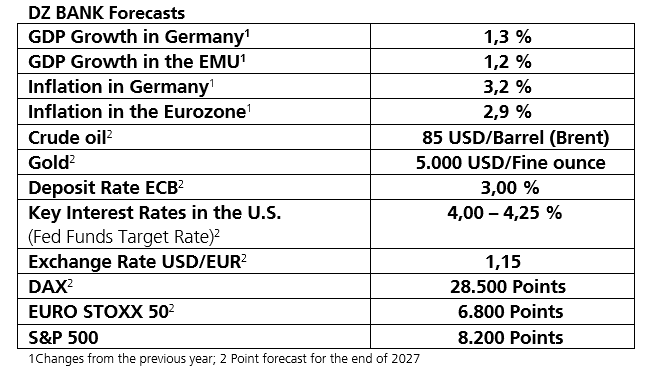
Despite the ongoing war in Iran and high energy prices, the global economy remains resilient. DZ BANK analysts expect global growth of 3.3 percent in 2027. This growth is supported by a rapid response to the energy shock, substantial investment in AI, and government spending programmes. Although Germany's economy is growing by 1.3 percent, the country still needs fundamental reforms. It will not be until the second half of the year that inflation will begin to decline. The European Central Bank (ECB) is therefore likely to raise interest rates twice by spring, whereas the Federal Reserve (Fed) is expected to raise rates only once more this year. Interest rate cuts are not anticipated in 2027. At the same time, high government debt is keeping yields at elevated levels. Rising corporate profits are boosting the stock markets. DZ BANK Research expects the DAX to reach 28.500, the Euro Stoxx 50 to reach 6.800 and the S&P 500 to reach 8.200 points by the end of 2027.

The world’s largest economy is expected to grow by 2.1 percent in 2027. “U.S. GDP is consistently strong. Even a volatile environment won‘t change that,” says DZ BANK Chief Economist Sonja Marten.
AI boom continues to drive investment in the U.S.
The AI boom has had a stronger impact on growth in the U.S. than anywhere else. The major cloud providers are expected to invest over 700 billion U.S. dollars by 2026, and this figure is predicted to exceed one trillion dollars next year. In addition, tax policy is supporting consumer spending, particularly among wealthier households. The rest of the population, however, remains cautious. “The K-shaped economy, in which income groups are diverging, will persist into 2027,“ emphasises Sonja Marten. The unemployment rate is expected to decline slightly in the new year and stabilise at four percent. Foreign companies continue to enter the U.S. market by setting up new production facilities. “This allows companies to avoid tariffs, and energy security is also greater locally than in other parts of the world,” says Marten. The U.S. economy should therefore gain momentum. However, high inflation and the growing mountain of debt are likely to act as brakes. Both keep yields high, which dampens economic activity. Furthermore, broad-based consumer spending is not expected to increase again until the second half of the year, when inflation eases.
Eurozone: Government Support – Lack of Private Investments
Government spending is also propping up the economy in the eurozone. DZ BANK forecasts growth of 1.2 percent for 2027. Unlike in the U.S., there is no privately driven investment boom, and deep rifts between political parties are hindering reforms. Furthermore, the EU’s Next Generation EU programme will expire at the end of the year. Its effects will continue to be felt for a while. In future, however, member states will once again have to finance their own investments using their own revenues. At the same time, spending on interest payments and defence is rising.
Germany Grows: Without Reforms, there will be no Sustainable Recovery
According to DZ BANK Research, the German GDP is expected to grow by 1.3 percent next year. The government will continue to be the strongest driver of growth. Higher consumer spending and investments in transport and digital infrastructure, defence and climate protection are expected to boost demand. These measures are expected to contribute 0.5 percentage points to overall growth. Although companies are investing slightly more, little momentum is expected. At least the declining-balance depreciation method, which applies until the end of 2027, is providing some support. Private consumption remains weak due to high energy prices eroding purchasing power. Foreign trade is not providing a boost. Although demand for German machinery and equipment for AI data centres is increasing, imports are growing even faster, particularly in areas such as defence equipment and components for the energy transition. “The real test is not to provide more government funding, but to generate private investment and productivity gains,” says Sonja Marten.
The real test is not to provide more government funding, but to generate private investment and productivity gains.
Regarding the reforms, she offers a mixed assessment. The federal government has indeed accelerated its efforts in the areas of health insurance and long-term care. However, the focus is on short-term financial stabilisation. According to Marten, the biggest challenge remains the pension system. A comprehensive reform package has yet to reach the Bundestag (German parliament). “Failing to implement reforms is not a form of relief, but a hidden burden on future generations,” says the chief economist. With the baby boomers retiring, the number of available workers is already declining. Marten criticises any further increase in non-wage labour costs as “poison for the business climate.” Adjustments to working lifespans and more funded pension plans are necessary. Other important factors for the business climate include better childcare, faster recognition of foreign qualifications, and reduced bureaucracy, for example through binding deadlines and digital applications.
More Restrictive: Fed and ECB continue to tighten Interest Rates
According to analysts, the Fed will raise interest rates by 25 basis points before the end of the year, after which the US central bank will keep rates on hold until 2027. DZ BANK Research expects the ECB to raise interest rates by 25 basis points twice over the next six months. The first will take place in December and the second in March. The deposit rate is then expected to remain at three percent next year.“Central banks can do little to counter energy-driven inflation. However, they must prevent inflation expectations from spiralling out of control,” says Marten. Falling energy prices should temper inflation in the second half of the year. Analysts expect an inflation rate of 3 percent for the U.S. in 2027. In the eurozone, this is likely to be slightly lower at 2.9 percent. Both of these figures will significantly exceed the ECB’s target.
Debt Drives Yields: There is no Comeback for low Interest Rates
The crises of recent years have caused many countries' debt levels to increase significantly. What was manageable when interest rates were low is now becoming a burden. Maturing bonds must be refinanced at higher costs, and interest payments are taking up an increasingly large proportion of household budgets. Investors are therefore demanding a premium to compensate for the risk. Analysts expect two-year U.S. Treasury yields to reach around four percent by the end of 2027, whereas the German equivalent is expected to remain below three percent. At the long end of the curve, however, yields are expected to decline only moderately compared to current levels. DZ BANK Research forecasts a yield of 3.10 percent for 10-year German government bonds and 4.80 percent for U.S. Treasury bonds by the end of the year.
The debt problem is particularly evident in the U.S. The national debt now stands at over 40 trillion U.S. dollars.
According to the U.S. Congressional Budget Office (CBO), the government will pay approximately one trillion U.S. dollars in interest during the current fiscal year. This is more than it spends on defence. At the same time, revenue has been lacking since the Supreme Court struck down tariffs based on an emergency law. However, Marten says, “As long as the economy is growing strongly, it’s enough for the U.S. not to let its deficit – currently around seven percent – grow any further. There’s no need for harsh austerity measures.“
As long as the economy is growing strongly, it’s enough for the U.S. not to let its deficit – currently around seven percent – grow any further. There’s no need for harsh austerity measures.
France: The Election year becomes a Test of Endurance
Since 2015, France’s debt-to-GDP ratio has risen from 97 to just under 116 percent. Analysts expect this figure to reach around 122 percent by 2028. The budget deficit has been remained five percent for years. The risk premium on French government bonds relative to German government bonds recently reached its highest level since 2012. Until the presidential election in spring 2027, France will remain the most significant event risk on the European bond market. “An election result alone will not calm the markets. France needs fiscal measures that can actually be implemented,” emphasises the chief economist. If the turmoil spreads to other countries, the ECB could come under pressure to intervene.
Tech Companies are Slowing the Decline in Risk Premiums
Analysts do not expect moderate relief for corporate bonds until later in the year. Consumer-related sectors and the automotive industry are under pressure. “AI is also taking its toll on the bond market. Although tech companies have top-tier credit ratings, they are issuing so many new bonds that their risk premiums are barely falling,” says Marten.

Earnings are Driving the Stock Markets: AI Must Gain Broad Acceptance
Despite war, inflation, and rising interest rates, the stock markets held their ground in 2026. For the first time in four years, it is expected that corporate earnings for the DAX, Euro Stoxx 50 and S&P 500 will have risen more sharply than stock prices. Sören Hettler, Head of Investment Strategy and Private Clients, is also optimistic about 2027. He forecasts 28,500 points for the DAX, 6,800 points for the Euro Stoxx 50 and 8,200 points for the S&P 500 by the end of 2027. These would be new records. “Earnings continue to rise, but stock prices are not keeping pace. High valuations are eating into a portion of those gains,” says Hettler. The bar is set high: The market expects earnings per share for the DAX to grow by around 15 percent each year over the next two years. The average over the past 15 years was just under 11 percent. In addition, bonds, with their higher yields, are once again competing with stocks.
AI remains a key factor in the stock market. “By 2027, however, it will no longer matter who invests the most in the technology, but rather ho makes money with it,” says Hettler. Companies that can translate AI into practical applications therefore have good prospects. These include software and industrial conglomerates above all. Along with financial stocks, they are among the most popular sectors. Banks are also likely to find favourable conditions. They benefit from a robust economy and higher interest rates provide favourable conditions for their core business. However, analysts see less potential in real estate and energy stocks. Ironically, falling oil prices could harm these sectors. This could benefit the German stock market. “Industrial and financial stocks carry significant weight in the DAX. If AI becomes widespread across the economy, the index will be well-positioned,” says Hettler.
Anyone looking to enter the stock market in 2027 should expect volatility. “Euphoria and disappointment are likely to alternate,” says Hettler. This makes stock selection all the more important. Large companies with pricing power and high profitability are well-positioned. Turmoil could be caused by a renewed escalation in the Middle East, doubts about government finances and the French election. Because expectations are high, even a noticeable downward revision in earnings estimates could trigger significant price declines. However, the fundamental drivers remain intact.

Robert Leonhardt
Pressesprecher
(Research, Digitalisierung und IT)